
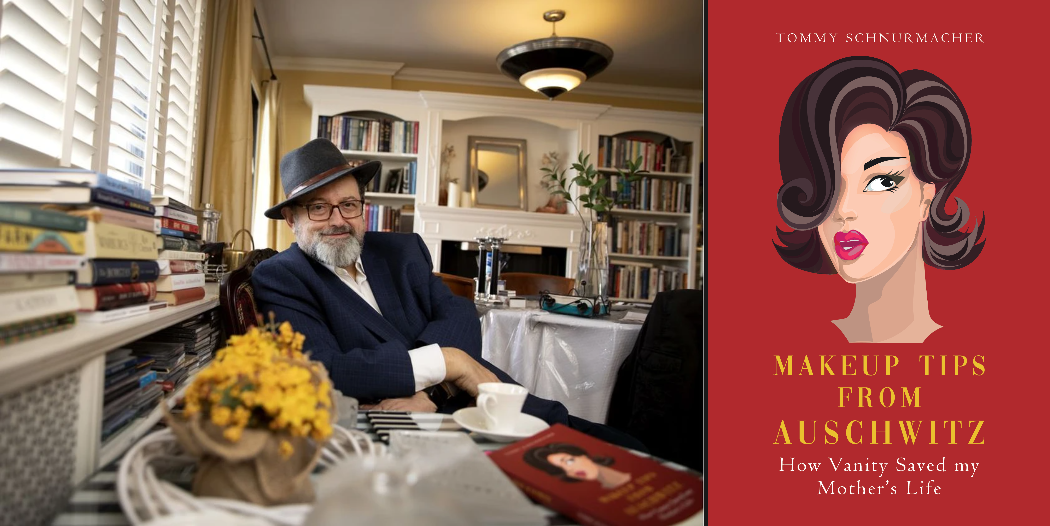
“She managed to get two world-famous Nazis to save her life.”
It’s not everyone who can say that about their mother. But then, as Tommy Schnurmacher’s remarkable memoir Makeup Tips From Auschwitz: How Vanity Saved My Mother’s Life (Tellwell, 272 pages, $19.95) attests, his was no ordinary mother, and theirs was no ordinary mother-son relationship.Schnurmacher has been a steady presence for two generations of English-speaking Montrealers: as a host at CJAD radio for more than 20 years (he retired in 2017), preceded by a long stint at the Montreal Gazette, for whom he was a popular society/gossip columnist. When a voice has been in your life that long, you can come to feel you know the person. But even Schnurmacher’s biggest fans may not be fully prepared for the personal journey he presents in the new book — a book he knew for many years he wanted to write.
“She’s such an overwhelming, looming presence in my life that not to write about her would have been unthinkable,” Schnurmacher said of his mother, Olga.
The choice of subject was easy, then. What was hard was getting started.
“I was too busy reading books on how to write, and how to sell a book once you’ve written it, to actually sit myself down and write it,” Schnurmacher said last week in his Côte-des-Neiges condo. “But what I did do all the time — and what I have always done — was write notes, and that came in very handy.”
Deciding in early 2018 to make daily posts on Facebook was a crucial spur, as were certain current events.
“I wrote out a cheque to the Re-Elect Donald Trump Fund,” he recalled. “I put it in an envelope, gave it to a friend of mine and told him, ‘I’m gonna send you 500-800 words every day. In the event that I miss a day, you are to mail this cheque.’ I did not miss a day. The Trump campaign is none the richer from me. I couldn’t let that happen.”
“She’s such an overwhelming, looming presence in my life that not to write about her would have been unthinkable,” Tommy Schnurmacher says of his mother, Olga. His memoir Makeup Tips From Auschwitz: How Vanity Saved My Mother’s Life is in the foreground.
Structured as a series of 51 short anecdotal chapters (or Pieces), the book eases the reader into its world. You might almost be lulled into thinking this is a series of gently comic stories in the time-honoured tradition of Jewish Mother humour. And it does work on that level. But as it proceeds, it morphs into something else; the laughs-to-pathos ratio gradually reverses, the sense of emotional investment deepens, and as you laugh along with Olga Schnurmacher’s eccentricities, you find yourself dreading her ultimate demise almost as much as her devoted son does. Makeup Tips From Auschwitz is the very best kind of testament to the transcending of evil — one that conveys myriad joys even while giving the devil his due.
The Schnurmachers arrived in Montreal as refugees in 1957, when Tommy was five, having fled the Hungarian Revolution. Before that, Olga had been in Auschwitz, where it was her vanity-fuelled determination to keep up appearances that literally kept her alive: she was selected on arrival by Josef Mengele as worthy of being a camp worker, and soon after by the notorious Irma Grese, known as the Beautiful Beast of Auschwitz, as her personal maidservant.
Tommy Schnurmacher dances with Olga at his bar mitzvah in 1964.
The pieces recounting the Schnurmachers’ early scuffling years in the Plateau serve as a social history of how life was for newly arrived postwar immigrants. The details emerge organically, insinuated rather than baldly stated, as when the author recounts how he was barred as a child from entering a spelling bee for no better reason than that he was an immigrant. For Olga’s part, a crucial coping mechanism was the invoking of her New World icons, among whom Elizabeth Taylor loomed especially large.
“When we came to Canada, none of us spoke a word of English,” recalled Schnurmacher. “We learned the language from movie magazines like Photoplay, watching late movies on TV, and reading movie ads in the paper. My mother loved the (1963) movie Cleopatra, would clip out everything about it. She also had a whole album of pictures of herself looking like Elizabeth Taylor. She was very proud of the resemblance.”
Schnurmacher’s account of his youth and young adulthood presents him as a kind of Montreal Zelig figure: he was an extra in the 1974 film adaptation of The Apprenticeship of Duddy Kravitz (“I’m wearing a beige cap, walking near a pool in the background”) and finagled his way into John Lennon and Yoko Ono’s suite at the Queen Elizabeth Hotel during their 1969 Bed-In, ending up along with a friend as de facto babysitter for Yoko’s young daughter Kyoko.
But while the author may be present on nearly every page of the book, it’s his force-of-nature mother who is the true animating figure here.
“I always had my mother on my side,” Schnurmacher said. “For example, as a child I couldn’t understand the concept of getting a note from your parents being a hurdle. My mother would write me notes for any purpose. She would write notes for other people’s children! The first day it got very cold, she said, ‘You can’t go to school. It’s too cold.’ I said, ‘But all the other kids are going.’ She said, ‘That’s because they’re Canadian, and Canadians don’t love their children.’ And as a kid, you believe that.”
While Olga and her rabbi husband were never reluctant to talk about their wartime and postwar experience, Tommy’s full awareness of the Holocaust came gradually and anecdotally.
“It bothered me that the other kids had grandparents and I didn’t,” he said of his earliest school days. “So I wanted to know why. When (my parents) told me the story, my gut reaction was, ‘I have to fix this. I have to undo it.’ I wanted it to have another ending. But how do you fix the Holocaust?”
It was a beginning of a theme that runs through the book, and indeed through Schnurmacher’s life: what he calls “mutual overprotectiveness” between parents and children. (Schnurmacher’s younger sister was born in Canada.)
“I felt very bad for my mother, because whenever she would tell the story, she’d be crying. I thought, ‘I can’t tell her any of my problems, because they’re nothing compared to what she went through.’ I came to believe it was my job to cheer her up — both because I believed it myself, and because she specifically told me it was. It was only later through psychologists that I learned that my job as a child was to be a child, not to parent my parents.”
As Schnurmacher was to learn, his situation, while extreme, was not unique.
“It’s a phenomenon among the second-generation children of Holocaust survivors — especially of immigrant families,” he said. “You’re the one who translates the world for them.”
And as he was to learn, fears get passed down.